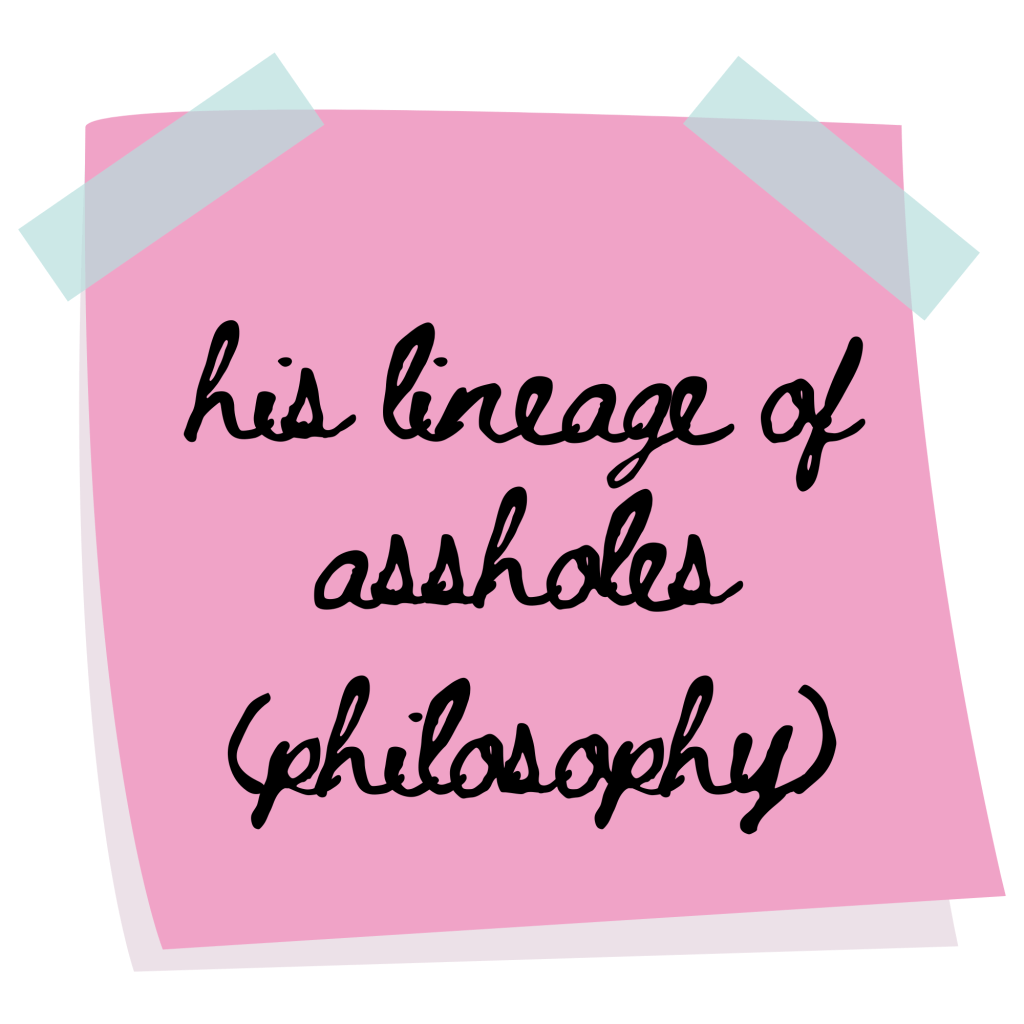
I have a foul mouth, okay? I attribute this mouth to early access to Comedy Central when I was a kid, as I would spend my midnights watching George Carlin stand-up specials. I view profanity as added color, but also, sometimes, as fact. There are moments when no other word describes a person’s behavior as accurately as asshole.
What is a lineage of assholes? The core of this train of thought began as I was reading some Greek mythology with my daughter. As we dug deeper into the mythology, I kept thinking, “Wow. This family is plagued by assholes.” Here we have Zeus, son of Cronus, who swallows Metis while she is pregnant with Athena because of a prophecy that Metis will eventually bear a son powerful enough to overthrow Zeus. Going back we see Cronus, who overthrows and castrates his father, Uranus, then swallows his own children because he fears they will overthrow him. And then there is Uranus, who imprisons some of his children inside Gaia because he fears and despises them. I realized at this point that the blame was going all the way back to the BEGINNING OF THE SKY. Men: Lovers, husbands, fathers, just passing down this toxic mindset that “Hey, remember what my dad did to me? I am going to kill/overpower him, then turn around and do the same thing to my own kids on repeat.” And that is how the phrase his lineage of assholes began.
This line in the movie Magnolia: “We may be through with the past, but the past ain’t through with us.” For whatever reason, this line stayed in my brain, and I realize that is the problem with a lineage of assholes. Nobody inherits only the story. We inherit ways of surviving the story. A child watches what love looks like when someone is angry, what power looks like when someone is afraid, what happens when somebody says no, who gets comforted, who apologizes, who is expected to absorb the discomfort of everyone else. None of this arrives labeled FAMILY HEIRLOOM. It arrives disguised as normal.
And then one day the child is an adult with their own anger, their own fear, their own people to love, and discovers that something very old has been living in their reflexes.
I thought about how to format this concept of generational trauma for a very long time, on many walks. Was this a poem? I started one, and it just wouldn’t work (it gave STRONG Jersey Shore vibes). And then I read The Imagined Life by Andrew Porter. The novel follows Steven Mills, whose wife and son have left him, as he drives through California interviewing people who knew his father, a fun(ish) professor who disappeared when Steven was twelve. Each person gives Steven another version of his father. Steven is not looking only for his father. He is looking for the point at which his father’s life entered his own. Importantly, he wants to know whether he is remembering his father, imagining him, resisting him, or repeating the very history that he despised.
It is beautifully written and so convincing in the first person that, for a while, I thought I was reading an autobiography. Steven’s memories arrive raw and fragmentary, much like our own. I never felt the presence of some author mastermind behind a keyboard, moving Post-it Notes around and consulting Excel sheets filled with character profiles, histories, plotlines, and timelines. The scaffolding disappeared. This felt real.
SPOILER ALERT: Near the end, when Steven is only 12, his father takes him on a drug- and alcohol-induced bender in the Hollywood Hills. It’s here that Steven tells his father what he thinks of him. And although Steven feels hatred for his father in that moment, it is not his father as a person that he hates. He hates what his father has done to him and his mother. Steven’s anger does not prove that he no longer loves his father. It proves that love has been forced to live beside fear, embarrassment, resentment, and disappointment.
Throughout the process of reconciling what this relationship shaped inside him, Steven remains at least partly aware of the path he does not want to follow. He still drifts toward it from time to time, so what we see is the tension between the self he inherited and the self he is still trying to choose.
Later, in his father’s friend’s (Deryck’s) car, Steven is offered a small act of empathy:
“And I appreciated also the way Deryck would turn around from time to time to check on me […] he reached into his glove compartment and pulled out a mix tape of songs by Stevie Nicks, a mix tape that he said he’d made for me a long time ago but had forgotten to give me, and then put it into the cassette deck, the song “Sleeping Angel” […] I realize now that this was an act of kindness, an act of empathy, and I think I must have realized it then too, because I didn’t say anything at first. In fact, I waited for almost the entire song to finish before I finally asked him to please turn it down, and then to turn it off, before I told him that I didn’t listen to that type of music anymore.”
He recognizes Deryck’s gesture as empathetic. He sees it and allows himself to feel it, but only briefly. He is not ready to receive that tenderness, so he retreats almost immediately into the stonier version of himself. It is safer there, especially for a child. The defenses that protect a child, however, can become something very different when carried unquestioned into adulthood.
And there is something almost perfect about the fact that Deryck gives him a tape. Because this entire story is about what gets handed down.
Some people hand us fear. Some hand us shame. Some teach us to disappear when anger enters a room, or to become angry first, or to turn tenderness down before tenderness gets the opportunity to leave us.
And then occasionally somebody hands us something else. A song: A small demonstration of what care looks like when it asks for nothing in return.
Perhaps inheritance is not only what travels through blood. Perhaps we spend our lives collecting other lineages too: teachers, friends, books, songs, people who show us a way of being that nobody in our family knew how to show us. Deryck’s kindness cannot undo what Steven’s father gave him. But it can sit beside it. Another model. Another possible self.
Perhaps that is true of many of the things that eventually save us. Someone offers tenderness when we are still too angry, too frightened, or too young to receive it. We insist that we no longer listen to that kind of music. But the song has already entered the story. Years later, we hear it again, and this time we recognize the person we were, the person we became, and the person we might still choose to be.
Back to those assholes.
Uranus wounded Cronus. Cronus wounded Zeus. Zeus carried the fear forward and called it self-preservation. The lineage explains each man, but it absolves none of them. Perhaps the cycle ends not when we stop carrying the wound, but when we finally refuse to place it into someone else’s hands.
And then we have to decide what we will hand them instead.
A different story. A different reflex. An apology. A mixtape.
Something they might not know how to receive yet.
Something they can play when they do.


Leave a comment